> For the complete documentation index, see [llms.txt](https://support.suptask.com/llms.txt). Markdown versions of documentation pages are available by appending `.md` to page URLs; this page is available as [Markdown](https://support.suptask.com/integrations-automations-and-workflows/integration-guides/notion.md).
# Notion
How to integrate Suptask with Notion
## Notion
The Notion connector links Suptask to your Notion workspaces. Once connected, the AI Assistant on an Inbox can use your Notion pages as a knowledge source and answer questions on tickets with information from your own documentation.
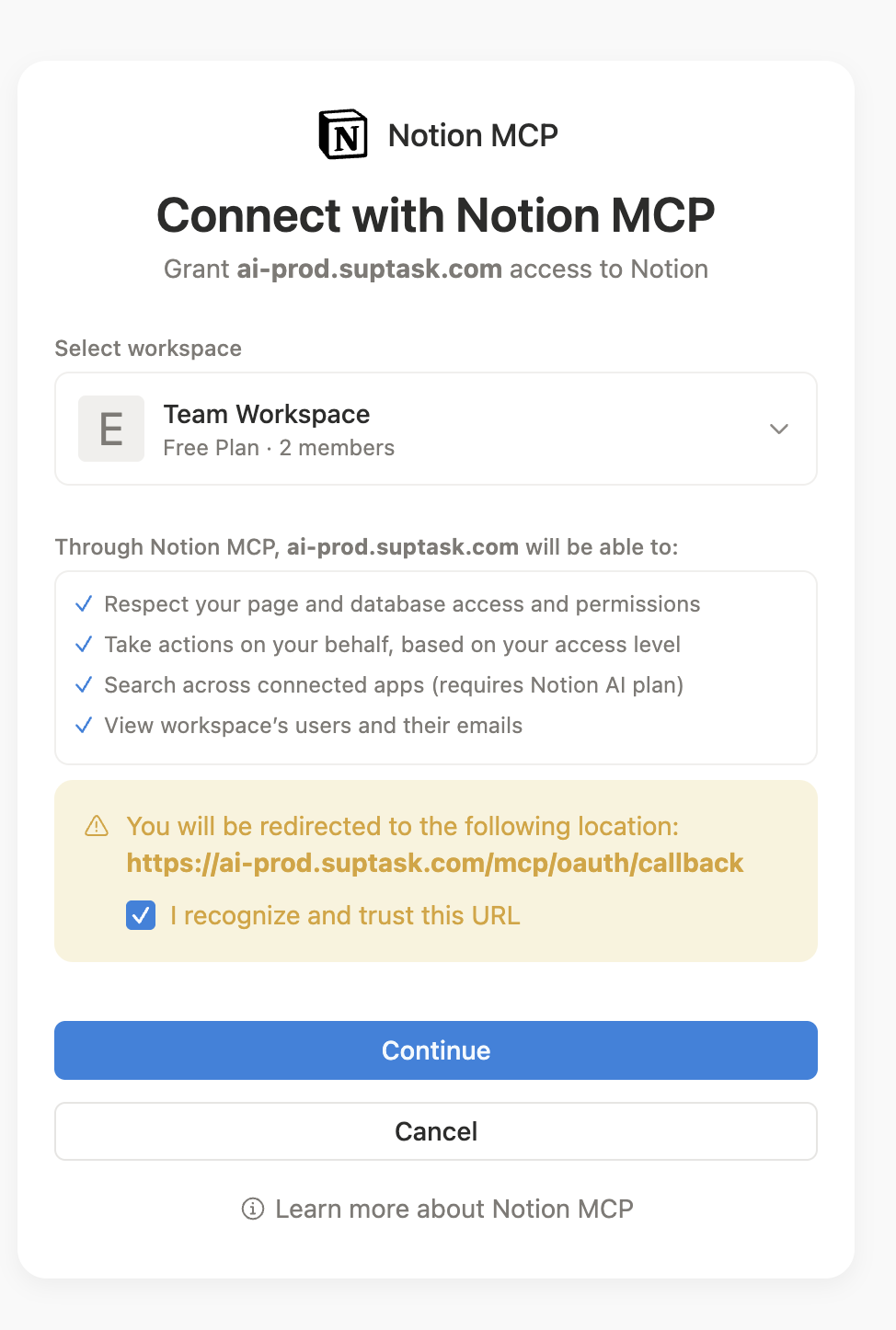
You connect Notion with OAuth by signing in as a Notion user and choosing which workspaces Suptask may access. All reading and management of Notion runs through this connector.
{% hint style="info" %}
You set up this connector in the Suptask Web App as an admin. Your agents and users then benefit from it in Slack while working on tickets.
{% endhint %}
***
### What you can use it for
* **Auto-answer requests** - a user submits a ticket, and the AI Assistant answers directly from your Notion documentation.
* **Support your agents** - agents ask the Assistant on a ticket and get an answer grounded in your internal pages.
* **Team-specific knowledge** - HR connects its own handbook pages, IT connects its own workspace, without either seeing the other's content.
* **Fewer repeat questions** — recurring questions that are already documented get answered without an agent stepping in.
***
### Before you begin
You'll need:
* An **admin** role in Suptask.
* A **Notion account** with access to the workspaces and pages you want Suptask to use.
* A decision on **which Notion user to connect** — this determines what Suptask can read. See the next section.
* The **Inbox** you want to connect Notion to.
***
### How access works
The connector inherits the access of the Notion user you sign in with. Suptask can read what that user can read, limited further by the workspaces you select during the connection flow.
This gives you two levels of control:
1. **Workspace level** - during connection you choose which Notion workspaces Suptask gets access to.
2. **User level** - the connected Notion user's own permissions decide which pages inside those workspaces are reachable.
{% hint style="warning" %}
Avoid connecting with a Notion admin account that has access to everything. The connector will be able to read the same content, including pages you did not intend to expose to ticketing.
{% endhint %}
***
### Set up the connector
1. In the Suptask Web App, open the **Inbox** you want to connect Notion to.
2. Go to the **AI Assistant** settings and open **Connectors**.
3. Add the **Notion** connector.
4. Click **Connect**. A Notion sign-in window opens.
5. Sign in with the **Notion user** you decided to connect.
6. Select the **workspaces** you want to give Suptask access to.
7. Approve the access.
When it's done, the connector status changes to connected.
{% hint style="info" %}
The connector provides a set of Tools to the AI Assistant. Permissions are set per Tool, so you can allow the Assistant to read your Notion content without allowing it to change anything.
{% endhint %}
{% content-ref url="/pages/EMXzCysY1oz2JPFXI8gH" %}
[AI Assistants](/suptask-ai/ai-assistants.md)
{% endcontent-ref %}
***
### Restrict what Suptask can read
If you only want the AI Assistant to use a specific set of pages, don't rely on workspace selection alone. Control it from the Notion side instead:
1. In Notion, create a **dedicated user** for the integration.
2. Share **only** the pages and databases you want Suptask to use with that user.
3. Connect the Suptask connector using that user.
The Assistant can then only answer from those pages, even if the workspace contains much more.
{% hint style="info" %}
Sharing a parent page with the dedicated user also gives access to its sub-pages. This is usually the easiest way to expose a whole documentation area at once.
{% endhint %}
***
### Use different Notion content per Inbox
Each Inbox in Suptask has its own connector. This means different teams can connect different parts of Notion:
* **HR Inbox** - connects to the HR handbook and policy pages.
* **IT Inbox** - connects to the IT workspace and troubleshooting articles.
* **Finance Inbox** - connects to expense and invoicing documentation.
A ticket in the HR Inbox is then only answered from HR content, and a ticket in the IT Inbox only from IT content. To separate access fully, connect each Inbox with its own dedicated Notion user.
***
### How to use the integration
This connector can be used within the AI assistants you set up within Suptask. You can both read and manage content.
Read more about how AI assistants works to understand all use cases.
#### Example usage
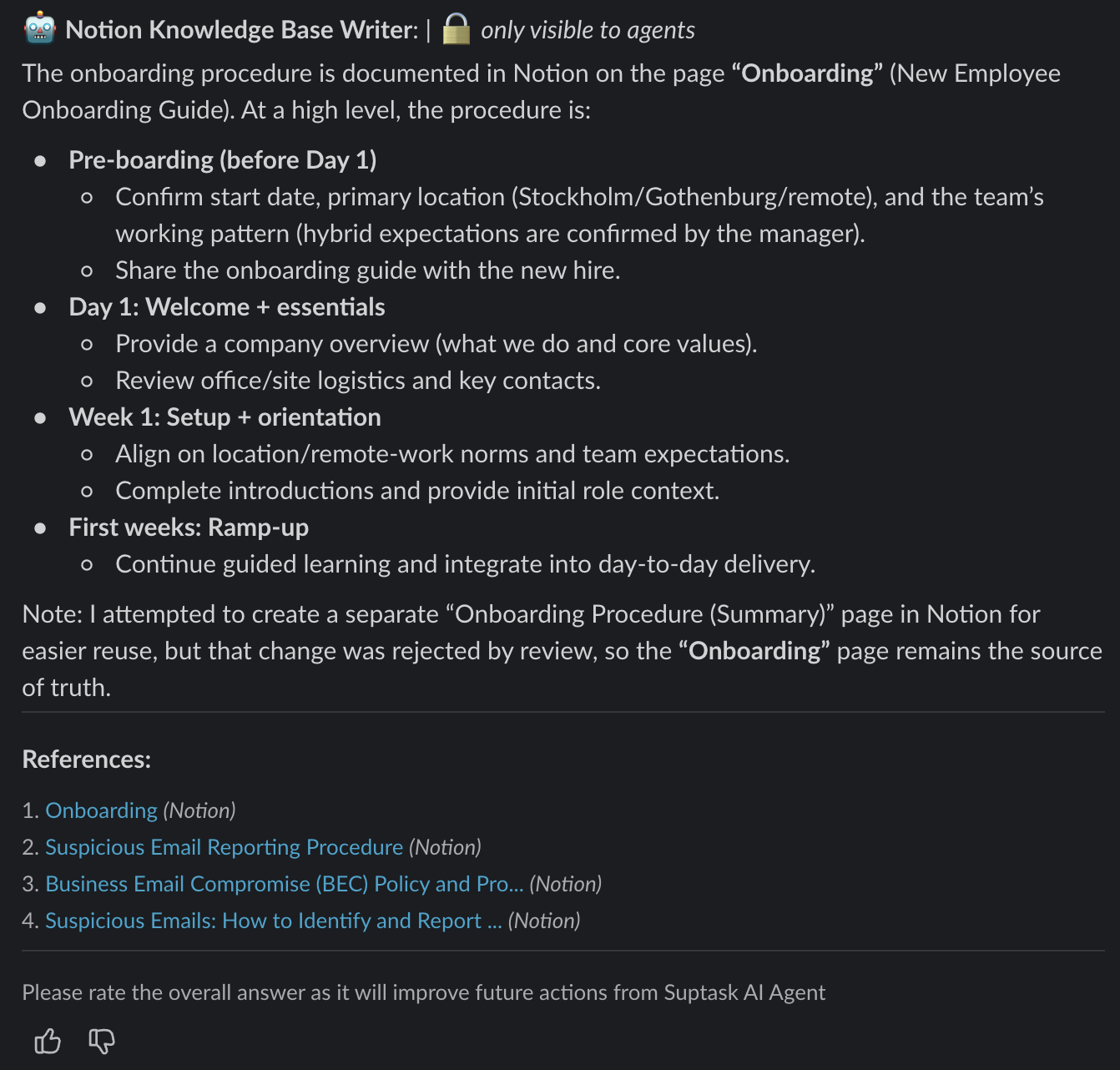
For a manual trigger, mention Suptask to ask questions about Notion documents.
Answers from the assistant is given directly in the ticket.
{% content-ref url="/pages/EMXzCysY1oz2JPFXI8gH" %}
[AI Assistants](/suptask-ai/ai-assistants.md)
{% endcontent-ref %}
### Troubleshooting
* **The Assistant can't find a page** - the page isn't shared with the connected Notion user, or its workspace wasn't selected during connection.
* **New pages aren't picked up** - make sure the new page sits under a parent that's already shared with the connected user.
* **The Assistant answers from the wrong content** - check which workspaces were selected on that Inbox's connector, and reconnect if needed.
* **The connector stopped working** - the connected Notion user may have been deactivated, or the integration access revoked in Notion. Reconnect the connector.
***
### Need help?
Reach out to [Suptask Support](https://support.suptask.com/getting-started/contact-support) and our team will help you connect Notion.